Showing posts with label $200M bond. Show all posts

Tuesday, March 24, 2026

Avelo Airlines and McKinney's TKI Contract Open Records Update

4/20/26 - Edited to add:
Avelo McKinney 2025 Contract pdf


On December 22, 2025, I filed an open records request with the city of McKinney for details of the Avelo contract for commercial airline service at TKI.

I decided to request the information when I found out the city and the city council of McKinney were using a 2013 resolution passed for a very specific purpose (to facilitate the transfer of airport assets after the city bought the airport in 2013) as the excuse to bury this contract without taxpayer oversight.  The land was not purchased for the soon-to-be commercial terminal until 2017-18

As of now, the current city council requires a public meeting to fund an FBO apron lighting project or to enter into an agreement to fund $158k in testing and observation services at the commercial airport. To have the city manager sign an agreement with an airline for an untold commitment of taxpayer funds without a public meeting, no public meeting is required. How does that make sense? 

Here is the entire ORR request: 


On or after the 10 day period, the city attorney sent a letter to the AG requesting a determination regarding whether some of the information can be withheld. The city specifically listed the following as the reasons it should be able to withhold information:

Section 552.110: Confidentiality of Trade Secrets and Confidentiality of Certain Commercial or Financial Information

Section 552.1101: Confidentiality of Proprietary Information -
the city requested Avelo file an "Affected Third Party" letter in support of it.

Section 552.101 in Conjunction with Chapter 418 of the Texas Government Code: Information Relating to Critical Infrastructure - Homeland Security Act, basically.

Avelo then filed an Affected Third Party letter (arguing in support of the city's desire to keep  the request secret under Section 552.110 and Section 552.1101 until after the terminal is built), which led to me learning that I have a right to send a response to those two letters to the AG for $7.50, which I did. 

On March 17th, nearly a full three months after my original ORR was filed, I got a response from the AG in the mail. The nearest I can figure out by reading the three page letter is that I will be getting most of the information, minus some technical details of the airport I didn't want anyway. 

Here are some snippets from the AG's letter:

"Based on these representations and our review, we find the city has demonstrated the applicability of section 418.181 to some of the information at issue, which we marked...However, we find the city has failed to demonstrate the remaining information at issue identifies the technical details of particular vulnerabilities of critical infrastructure to an act of terrorism or a hostile act by a foreign adversary of the United States. Consequently, the city may not withhold any of the remaining information..."

For Avelo's request to exempt disclosure because of trade secrets and commercial or financial information subject to section 552.101, the AG's office stated: 

"However, we find Avelo has failed to provide specific factual evidence demonstrating the remaining information at issue is a trade secret or constitutes commercial or financial information, the release of which would result in substantial competitive harm. Therefore, the city may not withhold any of the remaining information at issue under section 552.110 of the Government Code."

For Avelo's request to exempt disclosure under section 552.1101(a), the AG's office rejected that as well:

"Upon review, we find Avelo has failed to demonstrate the applicability of section 552.1101 (a) to the information at issue."

The AG's office notes that some of the remaining information might be protected by copyright. 

Hopefully, there is enough left of my ORR to get the contract and terms I requested. 


Sunday, February 1, 2026

McKinney Skirts Taxpayer Oversight with the Avelo Airlines Contract

The city of McKinney and City Council cite a 2013 resolution authorizing the city manager to sign contracts related to the acquisition of airport assets as the reason they bypassed the usual public disclosure and scrutiny when they signed the Avelo Airlines contract two months ago. Nothing was presented to the public either before or after the signing.

In an email answering why the Avelo contract did not go through the usual city council meeting process, Barry Shelton, McKinney’s Assistant City Manager, responded:
“In the case of the airport, the City Council back in 2013 approved a resolution delegating authority to “execute any contracts, leases, subleases, vendor or supply agreements necessary to operate and protect the Assets upon purchase.” “

Does that 2013 resolution really authorize the city to get by without taxpayer inspection and scrutiny with the Avelo Airlines contract?

Upon further inspection, the 2013 resolution specifically addressed the acquisition of airport buildings, hangars, and other business assets on land already owned by the city at the time of the resolutionin 2013.

The city of McKinney, however, did not even buy the land Avelo Airlines will be operating on until 2019. There were no assets for the city to buy in the 2019 land acquisition either. Why would the city think this resolution, which is specific to land already owned by the city in 2013, gives the City Manager blanket authority to authorize all future contracts for lands, assets, and airliner contracts not yet owned by the city for the airport now and forever?

There were also no public hearings at the meetings for either the 9/2013 or 10/2013 resolutions before this authorization was given to the then City Manager, Jason Gray. The resolutions were at least on public agendas, though. The agenda and video of the
9/2013 discussion is here. There was no discussion at all for the 10/2013 resolution.


Is the City thinking that Section 4 from the 10/2013 resolution authorizes any and all future airport business contracts be handled out of the public eye?

“Section 4. The City Manager is further authorized to execute any contracts,leases, subleases, vendor or supply agreements necessary to operate and protect the Assets (the “Related Agreements”), upon purchase. The City’s assumption,payment, discharge and performance of the Related Agreements are expressly conditionedupon Closing.” 


If the 10/2013 resolution legitimately allows the City Manager to enter into contracts without coming before City Council, why do smaller contracts, like the one for FBO apron lighting in 2024, come before City Council? 


The Notes Live music venue, on the other hand, has appeared before the City Council four times, each time the contract was revised. Shouldn't that be the standard for all city contracts?

As of now, the city of McKinney and Avelo Airlines are fighting the disclosure of the signed contract details in response to my open records request.

There is no doubt that the McKinney taxpayer is being left in the dark. The taxpayer must wait for the city of McKinney to voluntarily disclose the required financial details that will impact city finances for years to come. That is not how this is supposed to work, especially since the taxpayer is footing the bill.

Sunday, July 27, 2025

Taxpayer Input is Repeatedly Ignored in McKinney

The city of McKinney is inviting citizens to a public input session about the amenities they would like to see in the underground tunnel park (the inverted park), despite not being listened to when they expressed their opposition to a tunnel park in 2022. The invite on the city's social media page says, "We are planning a new community space under Hwy. 5, and we want your input!" Who wouldn't want community space under a highway?

The city says it wants input. Does it truly want taxpayer input, or is this public participation just a formality, as it was the last time the public was asked to weigh in on how east and west downtown could be connected?

McKinney's taxpayers might not remember, but there was a public hearing in July of 2022 regarding how to improve the pedestrian access between the west and east side of downtown. The public was quite decisive in its condemnation of the tunnel park option. The public voted to put the tunnel park idea nearly at the bottom of all other options presented, just above doing nothing.

A tunnel park requires additional funds for upkeep and extra money for security due to the inherent safety concerns associated with a tunnel park. Downtown McKinney continues to battle problems with homelessness and safety as it is. The additional yearly M & O costs of the tunnel park continue to fluctuate between $1M-$2.5M. Does that funding include the extra police needed? Are they using today's dollars to estimate, or will the price tag go up in the future when the additional police are actually needed?

The 2022 public input consisted of 4 options: Option 1 - deck Park like Klyde Warren Park in Dallas- an above-the-highway park Option 2 - tunnel park (an inverted deck park under a highway) Option 3 - improving the pedestrian crossings on Hwy 5 at a cost of under $1M Option 4 - doing nothing

Results of the public input from 7/22, click to enlarge


Public comments at the 2022 public input session showed a pattern of concerns regarding the expense and safety issues associated with the tunnel park option. As of the last City Council meeting on July 15th, regarding this issue, no plan has been discussed because it is said to be too far in the future. If that's the case, why are we being given a yearly M&O estimate now? Improvements to the existing crossings would have been less expensive with negligible additional yearly costs for taxpayers.

The tunnel park plan has never been a dream of the city's taxpayers. This vanity project was all the idea of the former mayor, George Fuller, during his time in office. When he first brought up the idea, it was presented as a Klyde Warren-type park with a park above the highway. Once the out-of-reach costs of this kind of park came to light, City Council just pivoted to the second most costly idea--a tunnel park. This decision by City Council was reached after the public input consensus was shared with them. In 2024, Pete Buttigieg, Secretary of Transportation during the Biden administration, visited McKinney to celebrate the awarding of funds from the Reconnecting Communities and Neighborhood Grant Program, part of the Investing in America initiative, for this project. This grant is not for the yearly costs to the city. 

The commercial airport is another example of taxpayer input being ignored in Mckinney. The city just held a secret airport groundbreaking for a commercial airport that was voted down twice by taxpayers. This was not an invitation-only, groundbreaking event that taxpayers knew about, but required limited attendance due to security. This groundbreaking was held in secret, only to be disclosed after the event took place. 

McKinney leadership's Citizen Survey ratings have declined over the years in key metrics, including honesty, transparency, treating residents fairly, and acting in the best interests of the community. Nevertheless, it does not appear that leadership is pausing to understand what caused the decline that began in 2021. 

Click to enlarge, results of the last citizen survey


Saturday, February 1, 2025

McKinney Seeks $73M for Budget Commercial Airport "Proof of Concept"

 At its January meeting, the McKinney Community Development Corporation (MCDC) heard from organizations and groups wanting grants. The long-controversial city airport came asking for $30M in financing. Grant requests will awarded at the February meeting. Earlier in January, the city asked the McKinney Economic Development Corporation (MEDC) for $22.4M.

                          City Presentation 

The city cannot use property tax money for three years after two failed commercial airport bonds (one in 2015 for the land and another one in 2023 for a terminal). While the city waits out the clock, its only recourse seems to be the MCDC and MEDC.

The city of McKinney asked the MCDC for a $30M bridge loan, either from the fund balance or by taking out sales tax bonds, until a federal Rural TIFIA loan can be secured. This would require at least two years of yearly $1M interest only payments. The city is prepared to have the MCDC carry the entire loan if the TIFIA loan does not work out.

The combined $52M ask is for a budget, “proof of concept” commercial airport they will use to woo a budget airline. There is still no firm commitment from an airliner. Here is the specific wording from the grant application:

“The proposed infrastructure will enable development of various aviation uses on the east side of the airport. The plan is to maximize flexibility to allow for growth in the future as the market and economy dictate. The proposed terminal is a small phase one terminal that is expandable but is intended as an inexpensive terminal to prove that commercial service is viable at TKI. If commercial service is successful, future expansion would include the construction of an entirely new terminal north of the first phase. The first phase terminal would continue to offer gates for the terminal or could be repurposed as a maintenance facility and/or rental car facility.” 


Both the MEDC and MCDC collect a half-cent each of sales tax revenue. That allotment translates into roughly $25M a year. The MCDC alone has saved over $47M in a fund balance for future unnamed projects—like the airport.

The MCDC left the public hearing open for the $30M commercial grant.
Please email the MCDC board at Info@mckinneycdc.org on agenda item # 25-2377.

There will also be a joint City Council, MEDC, and MCDC meeting on 2/18/25 at 4pm. The airport will likely be discussed.

For more background on the changing role of the MCDC, please see the following past articles:

McKinney’s Community Development Corporation Changes Focus

Demystifying McKinney's Airport

Sunday, November 3, 2024

Special Interests Finance McKinney’s Pro-Prop A PAC

PAC finance reports for and against the city council-driven term extension charter amendment on the ballot this November are posted on the city of McKinney’s website

So far, the pro-Prop A PAC, Citizens for McKinney, has brought in about $47,000 in individual, corporate, and in-kind donations to finance the campaign to pass city council term extensions. The corporate and business interest owners resemble those who donated to the recently failed $200M airport bond.

The top individual donors of $3,500 each were David Craig (of Craig Ranch, etc.), David Brooks (of Independent Bank and an earlier investor in TUPPS), David Johnson (?), and William Darling (Darling Homes and ManeGate). The PAC also received $500 each from Roeder & Hullett, two law firm members in town representing many apartment builders and companies with special planning needs. Two real estate company owners/brokers donated $2,000 each: McKissick and Franklin.

The top corporation donors totaled about $18,000:

Ashton Commercial Construction gave $3,000.
Tradition Homes gave $3,500 (a Bill Darling company).
South Beach Interests, LTD gave $1,000.
Burress Law gave $1,000.
DFW Law Office in Dallas gave $5,000.
SKRS Investments based in Addision gave $2,500.
Presidium Group based in Dallas gave $2,500 (multifamily real estate investment firm).

The anti-Prop A PAC, Keep McKinney Unique, was financed by mostly smaller donations from individuals, including a collaboration with a GoFundMe.com sign drive. In total, the majority of the donations ranged from $14 for one sign to $200 to help buy signs or pay for an education campaign. As of the 10/28 filing, about $6,000 was donated to the anti-term extension PAC.


There will most likely be one more filing for each PAC after the election is over on Tuesday. 


Sunday, September 29, 2024

McKinney’s Community Development Corporation Changes Focus

The current mayor and council members have slowly refocused the McKinney Community Development Corporation’s (MCDC) focus in what it funds and doesn’t fund. At MCDC’s recent strategic planning meeting held July 9th, the president of the MCDC, Cindy Schneible, said the following about the changing priorities:

“…I think our projects have that economic development cast, so we really need to think about how we want to report this out going forward. The larger percentage of our grants are outside of parks...It used to be a lot going to non-profit organizations for museum and entertainment, Heard Wildlife Museum, or Heard Craig, or Chestnut Square, and those are a smaller percentage of our overall grants that are being awarded. The big ones are airport and things like City Hall Plaza, Tupps, so…”


Three members of the City Council, Mayor Fuller, Pro Tem Feltus, and At Large Jones, were present and participated in the strategic planning process. This was an audio-only meeting that lasted over two and a half hours. I listened to the meeting and had it transcribed by an AI transcription service. 

Here are the key discussions and decisions from the meeting:

1. Airport–According to the Mayor, the airport will continue to get some funding from the MCDC. The recent $3.6M given to the airport for infrastructure was not a one-off.

2. Tunnel Park—The MCDC will also be asked to fund the underground tunnel park under Highway 5.

3. City Parks Funding—the ten-year requirement or directive for the MCDC to fund city parks a certain amount every year ($5.5M or so) will be ending soon. The directive will not be renewed; MCDC will just continue to fund it. A lack of a directive or requirement means that city leadership can decide at a future time to stop financing city parks. If the MCDC stops, citizens will have to cover the cost through their taxes.

4. The MCDC board made it clear that the relationship with MISD is broken. MISD makes it very difficult to rent space. MISD will also kick out those who rent space on short notice to make room for a school group. 

5. MCDC got the green light to pursue economic development deals, just like the MEDC. They will issue requests for proposals for what city leaders decide are priorities.

6. City leadership wants the MCDC to pursue convention space when that has traditionally been the job of the MEDC.

7. Leadership seems to want a luxury hotel. 
 
8. They want a community gathering place that is also a development of some sort.

Mayor Fuller spoke about a resort/hotel/convention space and the airport both being top priorities for the MEDC and MCDC. This audio was captured around the 1:30 range.

At Large Jones stressed the need to prioritize the following:

“I think, honestly, the airport, and just remember what the D stands for, whether it's EDC or CDC, it's development. Development. So when we talk about community development, what are we lacking? We lack hotel space. We lack entertainment venues. That's key. We can mow a lawn for parks all day long, but it's community development and economic development. So that should be the key priorities always. And it should be...You don't have a number on this. You just kind of list them out. Development.”

Mayor Pro Tem Feltus wanted to make clear that the MCDC should seek out developments to fund:

“I would definitely say I would like to see us be a little more proactive about finding the developments that are really right for McKinney. I think a lot of times, and this is not just CDC, but we kind of wait for things to come to us instead of us going to look for what really fits for us. How many of you guys have flown somewhere else, looked at a development, looked at an entertainment venue, a hotel, anybody on this board?”

MCDC’s current $35M fund balance reflects a clear change in funding priorities. Clearly, less money is going to community-type causes, and more money is being saved for development-type causes.

Because CDCs have such broad legal provisions governing how sales tax funds can be spent, city leaders can tailor goals at will. The MCDC board members are all appointed by the City Council. The City Council tells the MCDC what priorities should be pursued. 

Last February, the City Council voted 6-1 to ask the MEDC and the MCDC to fund the cost of infrastructure needed for a commercial airport (or maybe the expansion of the general aviation airport if the commercial airport does not pan out). This vote came nearly a year after the citizens of McKinney decisively voted down a $200M bond election to fully fund a commercial airport.

City officials spent nearly a year trying to figure out how to pay for a commercial airport without bonding through the citizens before finally settling on these two revenue streams. This city council resolution was for $3.6M from the MCDC.

The city council meeting was heated. Many in the community sent emails and spoke in person. They feared this one-time diversion of money to the airport would become the norm. They wondered what community events and non-profits would miss out on funding if the MCDC started paying for the airport as well as the MEDC. City Council chastised citizens from the dais for believing that the MCDC's commitment to the community would be changed.

Unfortunately, city residents' fears turned out to be reasonable. The MCDC's priorities have changed at the behest of city leadership.

Please see this past article regarding MCDC's funding denial of McKinney's own Heard Natural Science Museum & Wildlife Sanctuary here.


Saturday, September 14, 2024

McKinney Leadership’s Heard Problem

The 289-acre non-profit Heard Natural Science Museum and Wildlife Sanctuary is located on McKinney's east side. It is the definition of the kind of open space that fits McKinney’s “Unique by Nature” motto. It is a tourist attraction and a hidden gem for nature lovers.

Visitors canoeing, photo from The Heard's website 

Community groups meet at the Heard. School district and homeschool students learn about nature year-round. The Heard’s founder, Bessie Heard, was a woman ahead of her time and a downtown McKinney icon. With all the Heard has to offer, one would think the city of McKinney and its leadership would partner with Heard as they eagerly do with places like Tupps Brewery and the airport. Instead, the city of McKinney and its leaders push the Heard to the side.

The reason the Heard Natural Science Museum and Wildlife Sanctuary is problematic for McKinney’s leadership is simple— the airport. City leadership is on a mission to convert the general aviation airport into a commercial airport. Last year, citizens voted down a $200M bond meant for that purpose. This November's charter election will decide if the current mayor can have his term extended to continue his pursuit of a commercial airport. It is hard for the city and its leaders to concentrate money and effort on expanding the city’s airport when it is located right next to a nature preserve with a mission to educate, preserve, and conserve the environment. These two projects are close in proximity but worlds apart in their missions.

McKinney goes quite far to pretend the Heard does not exist. In the city’s 2040 comprehensive plan, the Heard is swallowed up in the so-called “Airport and Aviation District.” 

The Heard is located in the black circle at the bottom left of the aviation area.

The McKinney Community Development Corporation (MCDC) has been the primary financial support for non-profits like the Heard. The MCDC has given minimal yearly grant support to the Heard, similar to the grants the MCDC gives to fundraisers and cultural events in downtown McKinney.

Here's the history and purpose of the MCDC according to its website:

“In 1996, McKinney voters approved a half-cent sales tax to be used to provide grants to projects and events that would enhance McKinney’s aesthetic, cultural, and leisure amenities. Over the past 25 years, MCDC has invested nearly $225 million back into the community.”

The MCDC’s mission statement:

“Staying true to voter intent, we work proactively, in partnership with others, to promote and fund community, cultural and economic development projects that maintain and enhance the quality of life in McKinney.”

This year, the Heard applied to the MCDC for a $148,000 project grant to restore the Blackland Prairie area of its nature preserve. The application was formally presented to the MCDC board in April. The board asked five questions of the Heard representatives, ranging from interest in controlled burns to whether they could get a used tractor instead of a new one. Not one word was said indicating anything was wrong with their application. No other comments indicated a potential denial based on MCDC priorities or the inappropriateness of the application. *Oddly, project grants for community purposes, not just economic development, are now being discussed in MCDC's closed executive sessions

At the next MCDC meeting in May, the Heard’s project grant application came up for a vote. Not one person from the board said a word. After a lengthy silence, a member requested a vote to deny. The denial of Heard’s project grant request passed7-0. At the same meeting, the MCDC board approved a $3.6M project grant for airport infrastructure. The Notes Live for-profit outdoor amphitheater project was given $3M. Right now, the MCDC has a fund balance of about $30M. The Heard application looks like it was the only project denied this past fiscal year. 

Whether McKinney’s leadership likes it or not, the Heard is an asset to the city. It attracts tourism, educates citizens of all ages, and conserves and preserves open spaces. The Heard ticks all the boxes city leaders profess they want to support and promote. Whether a commercial airport is in McKinney's future or not, city leadership must find a way to work constructively with the Heard, just like it does with other non-profits in the city. 

Monday, February 19, 2024

Justified or Not, McKinney's Leadership Finds Other Taxpayer Funded Ways to Pay for a Commercial Airport

City leadership is advancing other city funding sources for the airport even though taxpayers voted down a commercial airport bond less than a year ago. They have decided that taxpayers voted down the commercial airport bond ONLY because voters did not want to pay for it with general obligation (GO) bonds.

1. This interpretation of the bond loss assumes taxpayers really want a commercial airport. Do they?

2. This interpretation of the bond loss also assumes taxpayers want to continue paying for the airport’s infrastructure and more; they just do not want to use GO bonds to do it.

Are the conclusions reached by city leaders legitimate, or are they a series of rationalizations made so they can continue pursuing airport expansion without firm taxpayer backing? 

The city of McKinney commissions reputable survey companies every other year to get the pulse of the residents. The 2017 and 2019 surveys asked questions about the airport. 

2017 official city survey

The results suggested a split city, much like the failed airport bonds in 2015, failing at 50.99% (for hangars and to purchase land on the east side of the airport), and a 2023 bond failed with 58.6% voting no (to build a commercial airport on the east side). Unsurprisingly, the 2021 and 2023 surveys asked no questions about the airport. 

2019 official city survey

Yearly, an unofficial budget priority survey allows citizens to rate their budget priorities 1-10 (1 being the most important and 10 being the least important). Nearly every year, the airport is rated at or near the bottom of importance for residents.
Citizen Survey | McKinney, TX - Official Website (mckinneytexas.org)

2022unofficial survey

At the 2/6/24 regular city council meeting, the Mayor of McKinney, George Fuller, doubled down in his interpretation. He said he commissioned his own survey with his own money. He read out the questions and results at the meeting. He claimed the results justify his interpretation of what voters said and did not say by defeating the bond. Here are the questions (based on my transcription of the video since the study he commissioned is not available):

1. Are you aware that McKinney owns TKI National Airport, located approximately five miles east of Central Expressway? 82.96% said yes, 17.4% said no.

2. Are you aware that 737 aircraft land and take off at the airport now? 44.93% said yes, 55.7% said no.

3. Are you aware that school and property taxes are collected on corporate assets, primarily jets, at TKI totaling more than $3 million a year, reducing our residential tax burden? 46.38% said they were aware, and 53.62% said no, they were not.

4. Would you support $200 million in bond debt paid for with property tax revenue for the development of a commercial passenger service at the airport? The question sounds familiar was on our last bond election. 40.58% said yes. 59.42% said no. I believe that's within about a percentage point of what the results were of the election if I’m not mistaken.

5. Would you support commercial passenger service at TKI if that service were negotiated with an airline and was provided without the use of any property tax backed bonds? 61.97% said yes and 38.3% said no.

His survey questions, particularly Q3 and Q5, were leading, limited in scope, and very telling in what information was omitted in the narrative. Unsurprisingly, his survey was tailor-made to get him the responses he wanted.

Notice that Q3 provided a supposed positive of the airport--$3M in property tax benefits to the city and MISD--without mentioning the other factors involved in the complicated funding structure of the airport:

  •  Not a mention that while bankrolling the entire airport, the city gets only about $800,000 of that $3M property tax benefit. That number has barely changed over the years, no matter how many new hangars the city builds. Why?
  • Not a mention that taxpayers put over $100 million into the airport since 2013.
  • Not a mention that the airport and surrounding commercial businesses are kept in a reinvestment zone (TIRZ2) while all city services inside the zone are paid for by the city. The potential tax benefit might be a wash after the city pays the liabilities for the TIRZ2 zone.
  • Not a mention that MISD is considered a tax-rich district with a large share of tax revenue it collects sent to the state due to recapture anyway.

Q5 fails to mention that taxpayers would possibly continue paying for commercial airport infrastructure and more through other means: general fund payments, payments through excess fund balances, draining the MEDC and MCDC of sales tax money that could be going to other high priorities for the city. What would the respondents have said if they had been given the complete picture in that question?

Armed with a carefully crafted survey done by Mayor Fuller, city leadership appears to feel justified in taking advantage of any taxpayer-funded source available to pay for the commercial airport (as long as it isn't GO bonds). Without skipping a beat, they will now ask the MEDC and MCDC (with members appointed by the city council) for undisclosed funding for undisclosed airport expenses using collected sales tax dollars. It is a stretch to use the MCDC, McKinney Community Development Corporation, money to pay for anything related to an airport. Community-related expenses that could be paid with MCDC will now have to be paid by other funds taxpayers have paid into.

How many commercial airport expenses does city leadership think the taxpayer will be paying to ready the site for an airline? When will the payments end for McKinney's taxpayers?


After bond fails, McKinney looks at other ways to improve airport (dallasnews.com)
McKinney voters pass five of seven bond propositions | Community Impact

Sunday, July 16, 2023

The Airport Bond Postmortem – Were There Warning Signs?

A lot of taxpayer money was wasted on the idea and execution of the airport bond from the moment the first consultant was hired in 2019. Were there signs that the city council would go on to spend $4M on consultants alone? Did we just miss the signs?

Were public hearings missed? Are there even public hearings for consultants? If not, would there be a total amount that might trigger a public hearing? Are there explicit wording requirements for the spending that can be seen on agenda items that aren’t public hearing items? Does the secret nature of this kind of economic development actually prevent public input and involvement?

The good news is that Mr. Grimes, the city manager, helped answer my questions. The bad news is that there was really no way for us to know what was coming. I know that when looked into the agenda items they were vague. Nor were there any ways we could have gotten involved in the decision-making process. That must change, or we’ll end up in this situation again.

I will just cut and paste his emailed answer because it is inclusive of all my questions:

"I have reviewed the approvals you reference below.  The consent agenda is where you will find many of our ordinances amending the budget and resolutions authorizing the City Manager to sign contracts.  While there is not a set contract amount threshold that, when crossed, requires an item to be moved to the regular agenda, larger contracts sometimes do get placed on the regular agenda to allow for a staff presentation.  Consent items are still on the public agenda, and the City Council can always request that a consent agenda item be pulled down for discussion.  If a member of the public wished for an item to be pulled down from consent and be considered individually, they can certainly speak at the public comment period and/or send a note to the council in advance requesting so.  My hunch is that at least one member of the council would grant such request, and every council member has the ability to exercise that discretion.


Below are the agenda items relating to the east side EA and the east side programming documents.  Of these items, the only public hearing was held during the TIRZ 2 Board meeting where $2 million was approved towards the programming document process.  Airport Director Ken Carley presented during this meeting and explained the request for TIRZ funding.


12/7/21 City Council Meeting – Agenda Item #21-1072 (consent) – Ordinance amending budget providing $550,000 for East Side Environmental Assessment

12/7/21 City Council Meeting – Agenda Item #21-1080 (consent) – Resolution approving contract with Garver for East Side Environmental Assessment


1/4/22 TIRZ 2 Board Meeting – Agenda Item #21-1183 (public hearing) – Resolution authorizing $2.0 million in TIRZ funds for East Side Programing Documents

1/4/22 City Council Meeting – Agenda Item #21-1170 (consent) Ordinance amending budget providing $1.5 million from Airport Operating Fund Balance and $2.0 million from TIRZ 2 Fund Balance for East Side Programming Documents.

1/4/22 City Council Meeting – Agenda Item #21-1173 (consent) – Resolution approving contract with Garver for East Side Programming Documents


3/7/23 City Council Meeting – Agenda Item #21-0166 (consent) – Ordinance amending budget appropriating $234,000 from the Airport Construction Fund balance to Airport Long Range Planning"


How many people would know what "East Side Programming Documents" meant? I know I thought they were talking about the runway extension that we already knew about.

If we asked our city council members what was going on at the time of the first or second consultant authorization, how many would have told us that they were in the planning stages of another airport bond, especially if they considered the airport an economic development that possibly included secret negotiations? It would be interesting to get their thoughts on this question. 

Transparency must be improved, especially in the case of consultants—any consultants.


Tuesday, May 9, 2023

An Airport Bond Failed, Again

Results are in, and the airport bond of 2023 failed worse than the last failed airport bond of 2015. 

Saturday's failed final bond vote (not official) showed a total of 21,846 votes cast. Of those votes, 41% were cast for the bond, and 58% were against the bond. It looks like a doubling of voters in an off-year election too!


Here are the results from the failed $50M airport bond election from November 2015 48% for the bond and 51% against the bond. A total of 10,473 votes were cast in that election.  

In this particular election, there were 7 propositions on the ballot:

Prop 1 Passed - street projects

Prop 2 Failed - airport improvements for land acquisition and hangar construction

Prop 3 Passed - public safety facilities

Prop 4 Passed - municipal building improvements for a library expansion

Prop 5 Failed - downtown parking structure

Prop 6 Passed - flood protection in some areas

Prop 7 Passed - to revoke $13M in park bond capacity (MCDC pays instead)


See the Community Impact article about the 2015 bond election


Saturday, April 15, 2023

Adding Context to the 1st Non-Official Filmed Airport Bond Q&A

George Fuller, acting as a citizen, hosted a McKinney Area Democratic Club Q&A at his business in support of the incumbent MISD school board members up for re-election and the $200M airport bond. The video is here.

I’m adding context to several things he said.

1.  (starting about 3:25) GF asserted that if the McKinney ISD school board members on the ballot are not re-elected, “…watch our school district go down in the tank and watch every company run for the hills.”

I’m sure he feels passionate about reelecting these incumbents, but MISD already has a lower rating than the surrounding districts (B instead of A). The district has also been slowly losing students since 2018, while surrounding ISDs continue enrolling more students. Maybe companies have been running for a while. Maybe their employees are choosing to be in other districts already.

Enrollments at MISD over the years

 Find this here, pg. 120


2.  (about 7:00) GF says, “It [the airport] kicks off about $3.5M in taxes, property, school, college, and county. Does everyone know why it’s important to everyone in the room? That means if they’re paying $3.5M worth of taxes, we’re not.”

How? How are taxpayers getting that back? The city and MISD collected more in taxes this last year than the previous year (even though the tax rate was lower due to property valuations being higher). Additionally, the money brought in through the airport reinvestment zone (TIRZ) is not even part of this calculation for the city. How does that fit in? 

City of McKinney


MISD

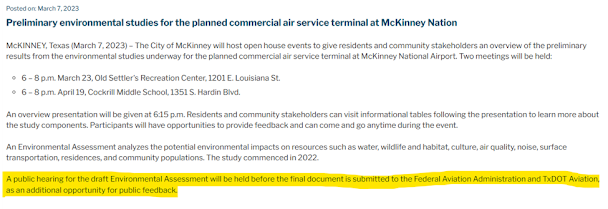
3.  (at about 14:00) GF says, “The FAA has reviewed and put out a first draft that they [garbled]…first open house, the second on April 19th, but they look at what’s the impact on water, wildlife, air quality, ground transportation…”

This statement is not correct. It is also misleading. The FAA is not performing this environmental assessment. McKinney Airport’s engineering firm of record, Garver, is performing the study that is still ongoing. According to the timeline given by Garver and all city information, the FAA has not gotten the preliminary report yet.

These two open houses GF talked about are hosted by Garver and the city. They are only open houses. Public hearings are required for public input, and those will not be completed until AFTER the bond election. The FAA is supposed to review the findings after the bond election too.

Here’s the city's explanation of the process:


Click here to see it on the city website.